



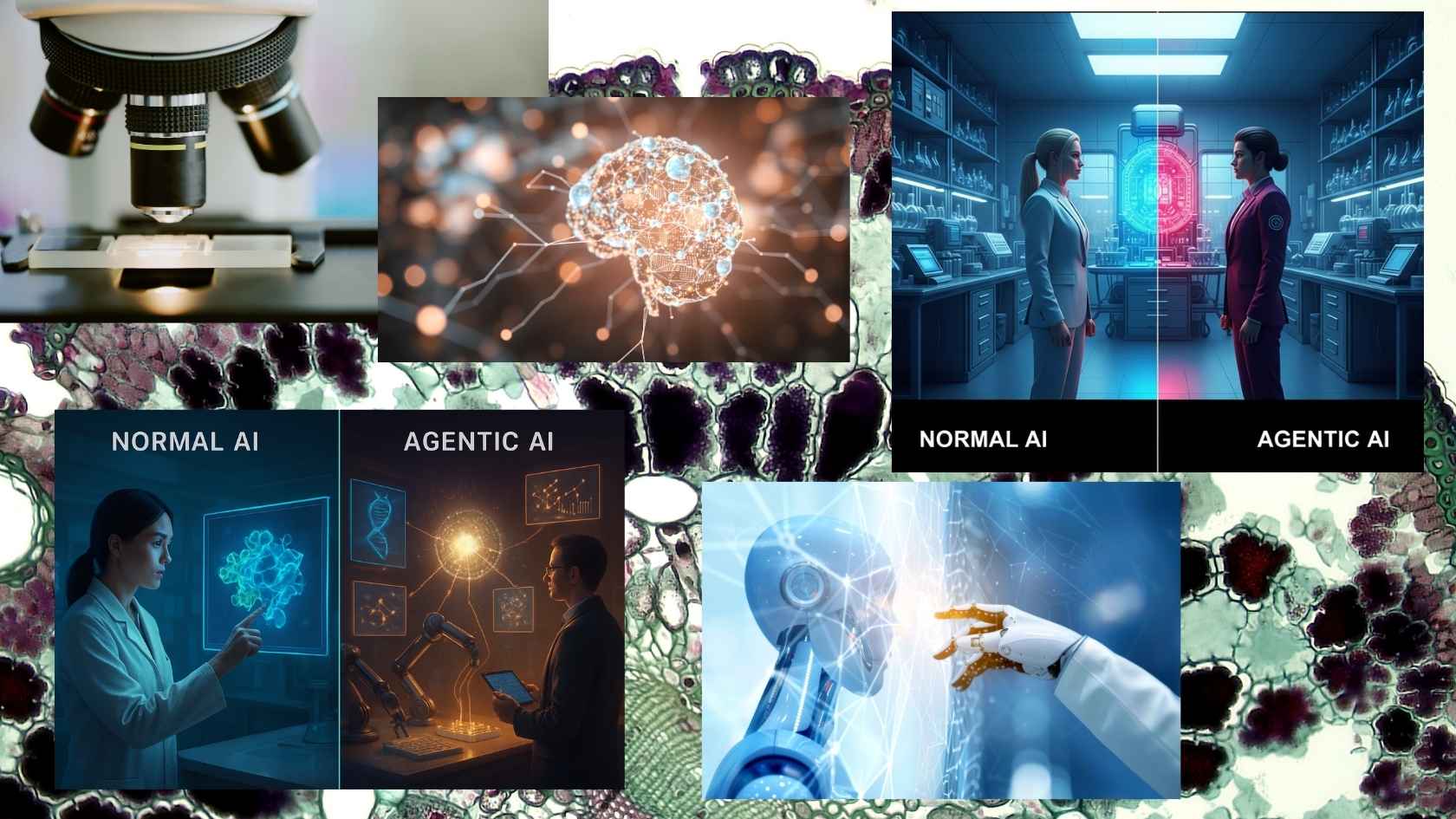
Artificial intelligence is no longer a futuristic buzzword in the life sciences; it’s a foundational tool. From predicting protein structures with unprecedented accuracy using models like DeepMind’s AlphaFold [1] to identifying cancer cells in pathology slides [2], AI is accelerating research at a breathtaking pace.
But what if I told you that most of the AI we use today is like a brilliant, hyper-specialized intern who only does exactly what you ask? And what if a new kind of AI is emerging—one that acts more like a junior research partner, capable of planning, executing, and iterating on its own?
This is the crucial difference between Normal AI and the paradigm-shifting concept of Agentic AI. Understanding this distinction is key to grasping the next revolution in biological discovery.
What is “Normal” AI? The Capable Tool
Think of the AI models we use today as incredibly powerful, specialized tools. This is what we can call “Normal AI” or “Task-Specific AI.”
- Analogy: A Swiss Army Knife, but for data. You have a tool for protein folding, a tool for image segmentation, and a tool for genomic analysis. Each one is a master of its craft.
- How it works: Normal AI is reactive. It waits for a specific prompt from a human. You give AlphaFold an amino acid sequence, and it gives you back a 3D protein structure. You give a diagnostic AI a retinal scan, and it flags signs of diabetic retinopathy.
- Key Characteristic: The human is the project manager. A scientist must take the output from one AI tool, interpret it, decide on the next step, and then feed it into another tool. It’s a powerful but human-driven workflow.
In biosciences, Normal AI is the powerhouse behind breakthroughs like:
- Predictive Modeling: Predicting how a drug will interact with a target.
- Image Analysis: Quantifying cell populations in microscopy images with deep learning models.
- Genomic Annotation: Identifying genes and regulatory elements in a DNA sequence.
It’s undeniably transformative. But its scope is limited to the task it was trained for. It doesn’t ask “what’s next?”
Enter Agentic AI: The Autonomous Collaborator
Agentic AI is a system designed not just to perform a task, but to achieve a goal. It is given a high-level objective and has the autonomy to figure out the steps to get there. This is made possible by modern frameworks, such as the “ReAct” (Reasoning and Acting) model, which enable Large Language Models (LLMs) to reason about a task, create a plan, and use external tools to execute that plan [3].
- Analogy: A junior scientist or a lab manager. You don’t tell them, “First, pipette 5μL into tube A.” You tell them, “Find a compound that inhibits this protein,” and they create and execute a plan.
- How it works: An AI Agent is proactive. It can:
- Plan: Break down a complex goal into a sequence of smaller, manageable tasks.
- Use Tools: Access and operate other software, databases (e.g., PubMed, PubChem), or even Normal AI models.
- Execute: Run the plan, calling on the tools it needs.
- Iterate & Self-Correct: Analyze the results of a step. If it fails or the data is inconclusive, it can adjust its plan and try a different approach.
Let’s imagine a task: “Identify potential drug candidates for Alzheimer’s-related Tau proteins.”
| How a Human using Normal AI would work | How an Agentic AI would work |
|---|---|
| 1. Human: Manually searches PubMed for the latest research on Tau protein targets. | 1. Agent: Receives the goal. Plans: “I need to identify targets, find compound libraries, run docking simulations, and check for toxicity.” |
| 2. Human: Uses AlphaFold (Normal AI) [1] to predict the structure of a specific Tau isoform. | 2. Agent: Executes Step 1: Accesses literature databases (PubMed, BioRxiv) to identify the most relevant Tau protein targets. |
| 3. Human: Searches a chemical database (e.g., PubChem) for similar-looking compounds. | 3. Agent: Executes Step 2: Uses a “Normal AI” tool like AlphaFold-as-a-service to model the identified targets. |
| 4. Human: Manually sets up and runs a molecular docking simulation for each compound. | 4. Agent: Executes Step 3 & 4: Queries chemical libraries (like ZINC or PubChem) for candidate molecules, then autonomously runs thousands of docking simulations using a dedicated software tool. |
| 5. Human: Analyzes results, gets frustrated, and repeats steps 3 & 4 with new ideas. | 5. Agent: Self-Corrects: “Initial hits have poor binding affinity. I will modify my search to include fragments and run a generative chemistry model to design novel compounds.” |
| 6. Agent: Reports: “Here are the top 10 lead candidates with predicted high binding affinity and low toxicity. I recommend synthesizing compounds A, B, and C for in-vitro validation.” |
The Implications for Biosciences: Why This Matters
The shift from tool to collaborator is not just an incremental improvement; it’s a fundamental change in how science can be done.
1. Accelerating the Entire Discovery Pipeline
Instead of speeding up one-off tasks, Agentic AI can automate and optimize the entire research “campaign.” It can work 24/7, tirelessly running virtual experiments, analyzing data, and formulating new hypotheses, compressing months of work into days. This integrated approach is seen as the next step in AI-driven drug discovery, moving beyond single-task models to holistic platforms [4].
2. Democratizing Complex Research
A small university lab or a biotech startup might not have a dedicated bioinformatics team. An Agentic AI could act as that “bioinformatician-in-a-box,” allowing researchers to ask high-level scientific questions and get back actionable insights without needing to master a dozen different software tools.
3. Uncovering “Unknown Unknowns”
Normal AI finds patterns we tell it to look for. An Agentic AI, given a broad goal like “understand the mechanism of this disease,” could independently pull data from genomics, proteomics, and clinical literature, potentially finding novel connections a human researcher might never have thought to investigate.
4. Closing the Loop with Lab Automation
This is no longer science fiction. A landmark 2023 study demonstrated an “intelligent agent” that bridged the digital and physical worlds. This AI agent, powered by GPT-4, was given access to the technical documentation for robotic lab equipment. It then autonomously learned how to use the equipment, planned, and successfully executed complex chemical reactions without human intervention [5]. This creates a fully autonomous, closed-loop cycle of hypothesis, experimentation, and discovery.
The Road Ahead: Caution and Collaboration
Of course, the path to fully realized Agentic AI is paved with challenges. We need robust safety guardrails, foolproof validation methods, and solutions for the “black box” problem to ensure we can trust the agent’s reasoning.
But the direction is clear. The role of the scientist is not disappearing; it’s evolving. We are moving from being digital tool operators to being the strategists, the creative question-askers, and the critical thinkers who guide our new AI research partners.
We’re at the dawn of an era where AI is not just a digital microscope for seeing the invisible, but a digital scientist working alongside us to solve the most profound mysteries of biology.
References
[1] Jumper, J., et al. (2021). Highly accurate protein structure prediction with AlphaFold. Nature, 596, 583–589. https://doi.org/10.1038/s41586-021-03819-2
[2] Bera, K., et al. (2019). Artificial intelligence in digital pathology—new tools for diagnosis and precision oncology. Nature Reviews Clinical Oncology, 16, 703–715. https://doi.org/10.1038/s41571-019-0252-y
[3] Yao, S., et al. (2023). ReAct: Synergizing Reasoning and Acting in Language Models. arXiv preprint arXiv:2210.03629. https://arxiv.org/abs/2210.03629
[4] Fleming, N. (2023). How AI is accelerating drug discovery. Nature, 624, S14-S16. https://doi.org/10.1038/d41586-023-03912-x
[5] Boiko, D.A., et al. (2023). Autonomous chemical research with large language models. Nature, 624, 570-578. https://doi.org/10.1038/s41586-023-06792-0

