



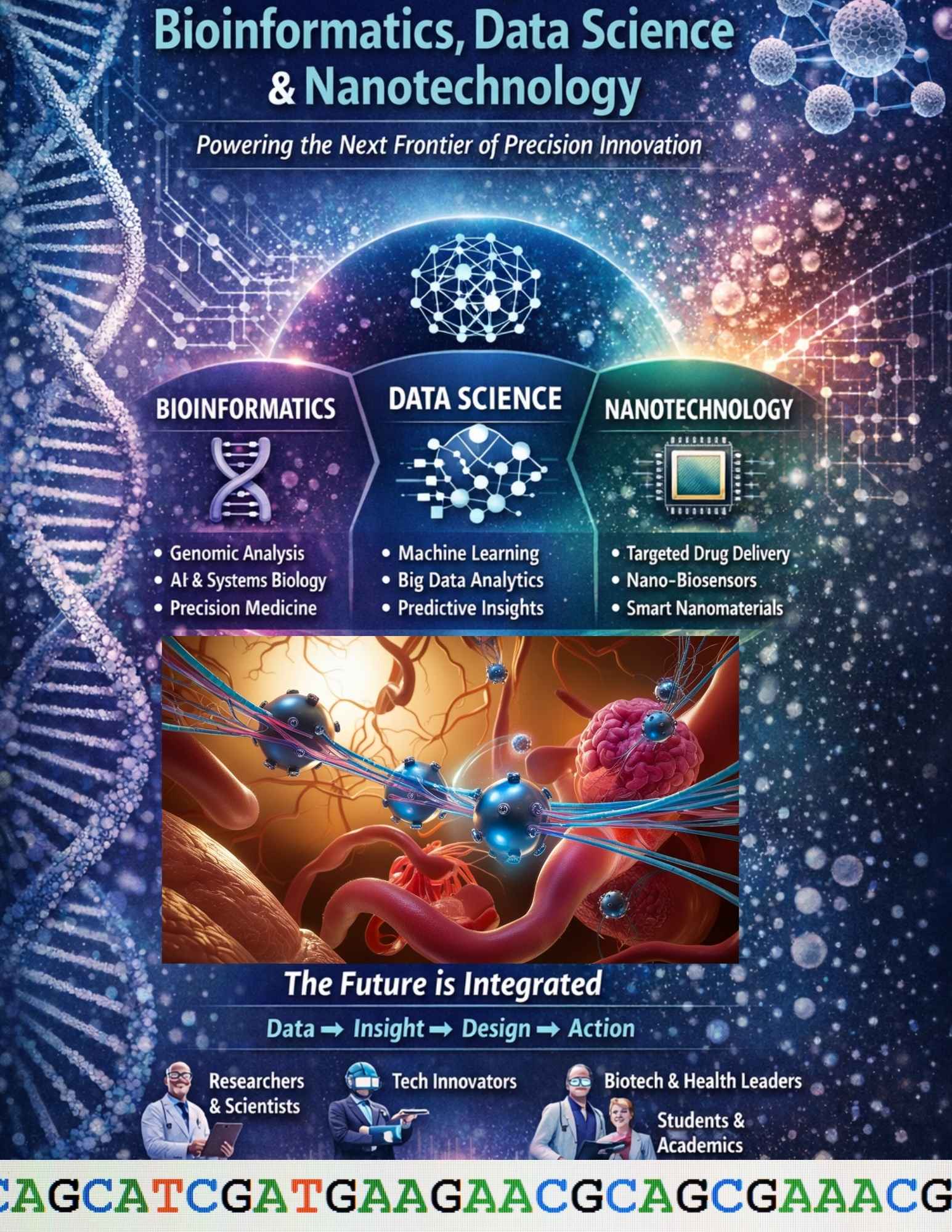
In the rapidly evolving landscape of scientific innovation, the synergy between bioinformatics, data science, and nanotechnology delivers unprecedented value across healthcare, materials science, environmental engineering, and beyond. This powerful triad is no longer confined to academic laboratories; it is driving industrial-scale transformation, with global leaders and emerging Indian innovators investing heavily in integrated platforms that merge molecular precision with computational intelligence.
For high-value stakeholders—research institutions, biotech investors, pharmaceutical giants, and tech-forward policymakers—understanding this convergence is not just insightful; it is essential for strategic foresight and competitive advantage.
1. Bioinformatics: Decoding the Biological Blueprint at Nanoscale Resolution
Bioinformatics leverages computational tools to analyze biological data, such as genomes, proteomes, and interactomes, to inform the rational design of nanomaterials with targeted functionality.
- Rational Nanocarrier Design: Nanoparticles used in drug delivery require precise surface engineering to bind to specific cellular receptors. Bioinformatics pipelines analyze transcriptomic data (e.g., from The Cancer Genome Atlas [TCGA]) to identify overexpressed targets in diseased tissues, thereby enabling cell-type-specific delivery [1].
- Protein Viral Prediction: When nanoparticles enter biological fluids, they adsorb proteins, forming a “corona” that dictates their fate in the body. Tools such as VromanSim and DeepNano use structural bioinformatics (often integrated with AlphaFold2) to model corona formation and predict biodistribution [2].
- CRISPR-Nano Integration: Bioinformatics identifies safe genomic loci and off-target risks, guiding the development of CRISPR-loaded lipid nanoparticles (LNPs). This approach underpins next-generation in vivo gene therapy [3].
2. Data Science: Transforming Nanoscale Complexity into Actionable Intelligence
Nanotechnology generates massive heterogeneous datasets, from cryo-EM reconstructions to real-time in vivo imaging. Data science transforms this complexity into a predictive model.
- Predictive Nanotoxicology: Machine learning models (e.g., random forests, graph neural networks) trained on databases such as caNanoLab (U.S. NCI) and NanoCommons (EU) predict biological responses based on nanomaterial descriptors [4].
- Autonomous Nanomanufacturing: Companies are deploying reinforcement learning to optimize nanoparticle synthesis in real time. For example, Insilico Medicine and Benchling offer AI-driven platforms that integrate with laboratory automation for closed-loop nanomaterial production.
- Digital Twins in Nanomedicine: Data-driven virtual replicas simulate the behavior of nanotherapeutics in individual patients, enabling personalized dosing and reducing clinical trial failure rates [5].
3. Global Industry Leaders Pioneering the Convergence
Several multinational corporations are embedding bioinformatics and AI into their nanotechnology R&D pipelines.
- Moderna (USA): Uses AI-driven bioinformatics to design mRNA-LNP formulations with optimal stability, immunogenicity, and tissue targeting, which are critical for cancer vaccines and rare disease therapeutics.
- Bayer (Germany): Through its Leaps by Bayer initiative, invests in startups like Vaxxas (Australia), which combines nanoarray patches with computational immunology for needle-free vaccine delivery.
- Roche/Genentech (Switzerland/USA): Leverages Flatiron Health (a Roche subsidiary) to integrate real-world patient data with nanotherapeutic development, enabling biomarker-guided nanoparticle trials.
- Samsung Advanced Institute of Technology (SAIT, South Korea): Developing AI-nanobiosensors for early disease detection trained on multi-omics datasets.
4. Indian Innovators Rising in the Nano-Bioinformatics Ecosystem
India is rapidly building capabilities at this intersection, supported by government initiatives and academic-industrial collaboration.
- Strand Life Sciences (Bengaluru): A pioneer in bioinformatics and AI-driven diagnostics, now expanding into nanogenomicsusing nanopore sequencing data with ML models to detect cancer biomarkers at ultra-low concentrations.
- Bugworks Research (Bengaluru): While primarily an anti-infective drug discovery company, Bugworks integrates nanoparticle delivery systems with genomic resistance profiling, backed by bioinformatics pipelines to combat antimicrobial resistance (AMR).
- NanoSniff Technologies (IIT Bombay spin-off): Develops AI-enhanced nanosensors for explosives and disease biomarkers and uses deep learning to interpret nanosensor array outputs in real time.
- CSIR–Indian Institute of Chemical Technology (IICT, Hyderabad): Collaborating with Biocon and Dr. Reddy’s Laboratories on nanoformulations of biologics, guided by computational absorption, distribution, metabolism, excretion, and toxicity (ADMET) modeling.
- Government Support: The Department of Biotechnology (DBT) and Department of Science & Technology (DST) fund national missions such as the “Nano Mission” and “Biotechnology Industry Research Assistance Council (BIRAC),” which increasingly emphasize data-driven nanomedicine [6].
5. Strategic Implications for High-Value Stakeholders
- Investors: Look for deep-tech convergence plays, such as startups combining AlphaFold-like protein prediction with nanoformulation platforms. Indian seed-stage funds, such as Aavishkaar, Omnivore, and Blume Ventures, are increasingly backing such ventures.
- Pharma & Biotech: Integrating bioinformatics-data science stacks into nano-R&D can compress preclinical timelines by 18–24 months and improve clinical translation success rates by 2–3x.
- Policy & Regulation: The FDA’s Emerging Science Program and CDSCO’s (India) Draft Guidelines on Nanomedicines (2024) both emphasize standardized data reporting and in silico safety assessment, aligning with global nanoinformatics frameworks such as ISA-TAB-Nano [7].
6. The Road Ahead: Autonomous Nanosystems and Quantum-Accelerated Design
The next frontier involves programmable nanorobots that sense, compute, and act within the body. Bioinformatics provides biological logic, data science supplies adaptive decision algorithms, and nanotechnology delivers hardware. Companies such as Nanome (USA) are already using VR + AI to design nanomaterials in immersive 3D environments.
With the advancement of quantum computing (e.g., Tata Consultancy Services’ quantum initiatives in India and IBM Quantum globally), molecular simulations will achieve unprecedented fidelity, enabling atomically precise nanomachines designed entirely in silico.
Conclusion: A Global Race, with India in the Vanguard
The integration of bioinformatics, data science, and nanotechnology is no longer a niche; it is the engine of precision innovation. Global giants are scaling these platforms, while India is emerging as a high-potential hub with strong academic foundations, entrepreneurial energy and strategic government backing.
For organizations at the apex of science and strategy, the question is no longer whether to engagebut how fast.
Conclusion: A Global Race, with India in the Vanguard
The integration of bioinformatics, data science, and nanotechnology is no longer a niche; it is the engine of precision innovation. Global giants are scaling these platforms, while India is emerging as a high-potential hub with strong academic foundations, entrepreneurial energy and strategic government backing.
For organizations at the apex of science and strategy, the question is no longer whether to engagebut how fast.
Call to Action:
Evaluate your R&D strategy through the lens of triple convergence. Partnership with bioinformatics-AI-nano integr Monitor policy shifts. We consider India not just as a market, but as a co-innovation partner in the next wave of molecular intelligence.
Source-
Weinstein, J. N., et al. (2013). The Cancer Genome Atlas Pan-Cancer Analysis Project. Nature Genetics, 45(10), 1113–1120.
Tenzer, S., et al. (2013). The rapid formation of a plasma protein corona critically affects the pathophysiology of nanoparticles. Nature Nanotechnology, 8(10), 772–781.
Rosenblum, D., et al. (2020). CRISPR-Cas9 genome editing using targeted lipid nanoparticles for cancer therapy. Science Advances, 6(47), eabc9450.
Thomas, D. G., et al. (2019). NanoMiner: A machine learning approach to nanomaterial risk assessment. ACS Nano, 13(5), 5150–5163.
Viceconti, M., et al. (2022). Digital twins for precision nanomedicine: A roadmap. Nature Nanotechnology, 17, 885–891.
Department of Science & Technology, Government of India. (2024). National Nano Mission Phase III: Strategic Roadmap 2025–2030. New Delhi.
Baker, N., et al. (2020). ISA-TAB-Nano: A standard format for nanomaterial data sharing. Nature Nanotechnology, 15, 186–190.

